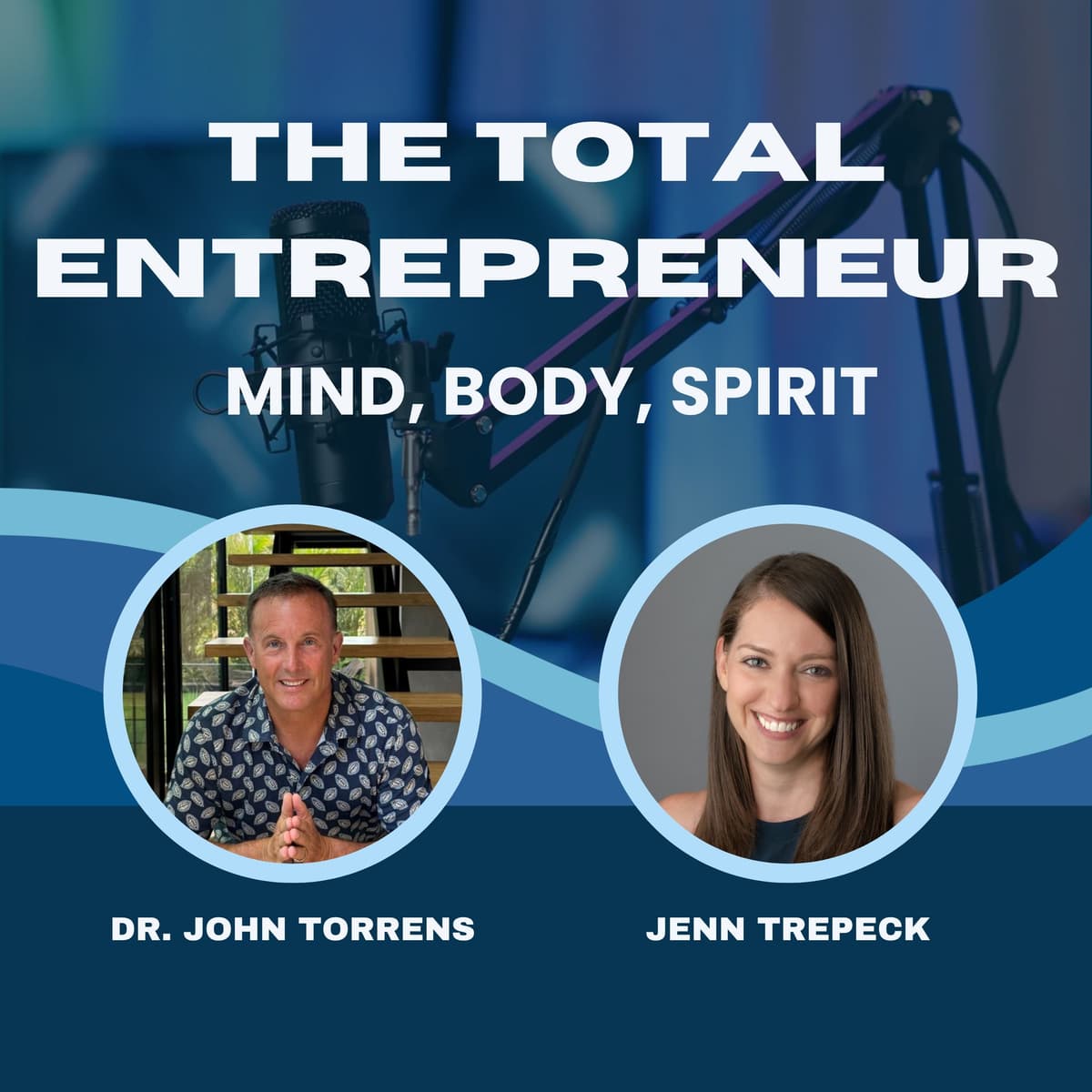
The Entrepreneur's Nutrition, Sleep, and Pacing Formula | Jenn Trepeck
with Jenn Trepeck
Aug 20, 2026 · 00:48:48
Part of our conversations on
The only difference between a meal or a snack is how much food we have at a time, and then therefore how long it's going to last us until we need to fuel again.
Jen, welcome to the podcast. So nice to have you here.
Thanks so much. I'm excited for our conversation.
Yeah, me too. Well, so first, tell me a little bit about Salad with a Side of Fries. I noticed that's your website, is your podcast, and it's a cool name. I'd love to hear your take on, on why.
Absolutely. So, we've become known as wellness without the weirdness. And that's, you know, it's salad with a side of fries. It's have the things, all of it, you know, even the fries too sometimes. And, um, this wasn't actually the branding when I started my business. So, I first started health coaching back in 2007. It was like before side hustles were a thing, before health coaching was even really as much of a thing as it is now. And my business at the time was called Better Life Now. It made sense in the early 2000s.
Sure.
And so, Built my practice on the side for 12 years. So, 2019, left my full-time job, launched the podcast. The podcast—
What were you doing as a full-time job before you left?
I was a photo shoot producer, and then I worked in hedge funds for 12 years.
Okay.
Almost. Yeah.
All right.
And, uh, yeah, that's a whole other can of worms.
Right.
And, um, so I left my full-time job, launched the podcast, The podcast was called Salad with a Side of Fries and then eventually rebranded everything under Salad with a Side of Fries. It was just, you know, the branding of early 2000s didn't resonate anymore. And, as you said, Salad with a Side of Fries had sort of taken on this life of its own that people really resonated with.
Mm-hmm.
And, I said, you know, we've become known as wellness without the weirdness. The other piece that sort of happened over time is that it's almost become like this beacon. where if someone gets it, they're in. And the people who say, I don't get it, I think it's okay. The show's not for you. We may not be friends. All is well.
Yeah. Yeah, no, I like that. Yeah. And actually, as I was reading it, it kind of struck me, you know, just the 80/20 rule, right? You have salad 80% of the time, you get your little side of fries 20%, and all's good. And we don't have to be perfect all the time, right? We just have to do the best we can most of the time.
So, exactly.
Yeah. Yeah. Well, speaking of food, I was just wondering if you can give me your take on the state of food in the US in 2026. I mean, I spent some time in Costa Rica, like I was telling you, uh, before we started recording, and I feel like the food I have access to there is just so much better for me. It tastes better. It is better. And shortly after arriving back in New York, I can feel symptoms in my body that I didn't have when I was there. So, Yeah, what is going on with food in 2026?
How much time do we have?
Right? Well, I love this topic, so yeah, go for it.
So, the state of food is rough. Like, long story short, it is rough. And we have gotten here over time through a confluence of factors. Fundamentally, you are 1,000% correct. That even an apple today does not have the same nutrition as an apple that we ate 40 years ago, or our grandparents ate 60 years ago, because of our farming practices, because of importing foods, and on and on, because of GMO foods. which are now also called BE. So, for anybody reading labels, GMO is now written on labels as BE, which stands for bioengineered.
Hmm.
And, it's funny because people always talk about the issue with the genetically modified foods in terms of the pesticides. And things like that. Now, the interesting piece that I've never heard people talk about in detail is the fact that bugs don't eat them.
Hmm. I've seen— yeah, I've read about this.
Well, the bug doesn't eat it because the bug can recognize that the leaf is not a leaf, the tomato is not a tomato. We sit here and go, Well, it looks like a tomato. It looks like lettuce. It must be. So then we eat this thing and it's— the body doesn't recognize it like lettuce or tomato or whatever it is. And so of course you have challenges. Now another interesting piece is grains. So taking produce out of the mix, even grains that we eat, we have seen over the years a dramatic rise in gluten sensitivity and gluten allergy, which is celiac disease. And a lot of people can go to Europe and eat pasta and bread and feel totally fine.
Right.
And we're like, what is it? So we mostly in this country use what's called modern wheat. Across the world, they tend to use ancient wheat. Well, the guy who invented— forgive me, I can't think of his name— the guy who invented modern wheat, I think it was like in the '70s or so, won the Nobel Peace Prize for solving world hunger because modern wheat, you could get so much more output out of the same input. Well, modern wheat also has dramatically more gluten in it than ancient wheat. Now, fast forward 50, 60 years later, whatever it is, because I can't remember the year, right? We have this dramatic rise in gluten issues, but no one's connecting it to our food supply. You know, the dramatic rise in a lot of diseases, I believe, are connected to not just the quality of our food supply, but also the fact that we're one of only a handful of countries in the world where healthful, nutritious, fresh food is more expensive than the highly processed food-like substances. And so, my little platform is that we could dramatically reverse the health and disease in our country if we were to shift how food pricing happens, what happens in terms of the regulatory agencies, and— You know, making those food-like substances infinitely more expensive than the quality helpful foods.
Yeah. I like how you said food-like substances because it's really not even food and it's, it's kind of overwhelming, right? Because, you know, you talk about soil depletion and then you talk about pesticides. I mean, we're, we're putting poisons on our food so that other living organisms won't eat them so that we can eat them, which kind of like to your point is it doesn't even really resemble what it originally was. And then you've got, you know, the preservatives and the storage and the fact that, yeah, you think you're doing good by eating that apple or some kale or whatever, but it's not even really the kale that our grandparents had access to or that we even had access to when we were kids. So I think as much as you—
Which isn't to say don't eat it. Like, still eat those things. Exactly.
It's still better than the Doritos, 100%, right? But I think it's hard. It's frustrating for people. Well, and not only that, but then they don't even have fresh foods, whole foods available in the first place. It's very difficult, right? So I heard the term food deserts, like, you know, where there's no grocery stores. Now the new term is food swamps, where all you can find are ultra-processed foods in packages and nothing fresh. So, yeah, I understand why it's frustrating for people because there's just so many parts of it that are kind of messed up.
Exactly.
Yeah. Yeah.
Here we are in our corner of the world doing what we can, you know.
No, I know. And, you know, it kind of, it's tough when, Yeah, you mentioned, you know, going to Europe and being able to eat grains. Yeah, it's tough when we just know we're fed things that the rest of the world kind of outlaws. Like, you know, they won't feed their citizens petroleum in their foods, you know, but we can. So it's, yeah, it's a little weird. So what do you, like, if you have clients who are struggling with this, what do you do? How do you help them? Or what's your guidance for people in that situation?
Yes. So, in fairness, it typically takes about 12 weeks to get through all the things that we share.
Interesting.
But, it's really about understanding how the body uses food that fundamentally calories in, calories out is not how the human body works and that it's the quality of those calories that determine whether our body is hospitable for health or hospitable for disease. And we get to create that. The big piece that I hope everybody understands, even from our conversation today, is that, you know, true healthcare, taking care of your health, taking care of your business is taking— you know, taking care of your health is taking care of your business. And taking care of your health is not showing up to your doctor once a year. That, at best, is early detection. True healthcare are the seemingly small decisions that we make every single day. And going back to even what you were saying before, we want to make sure that perfection isn't the enemy of progress. And we have and create a plan for ourselves that works for our life rather than only works when we have no life.
Right.
You know?
Yeah.
And because I see it all the time, people are like, well, I've done this and then that stopped working, or I was doing this and now I'm off, right? If our plan has this on-off, good-bad thing, it's not a plan, it's rules.
Mhm.
And we need a plan that includes the fries, includes holidays, includes vacation and birthdays and all of the things that we want in our life. That is why we're doing all of these extra things.
Right.
And so, I think a big piece is also even coming back to what does wellness look like for you so that you know where you're headed, just like in business, and then we can decide on what our path looks like to get there. Mm-hmm.
And are there some basic universal truths, right? Like, yes, don't take a shot of sugar first thing when you wake up in the morning, or, or say, you know, something that everybody can apply no matter what.
Yes. So because I think a sugar thing, a caffeine thing is, you know, pretty out there on the internet. Um, one of the things I say this on almost every one of my episodes and, you know, all of my clients learn it, so I will give it to all of you. If you're a note taker, grab a pen. Protein and fiber at every meal makes removing fat no big deal. Protein and fiber at every meal makes removing fat no big deal. And frankly, whether removing fat is your health goal or not, it makes health no big deal. Like, this is fundamentally how we eat as humans. So protein is clean, lean protein. I don't care if it's animal or plant or something we have yet to discover, but clean, lean protein. Fiber is vegetables and sometimes fruit. These are carbohydrates. Your body's preferred fuel is carbohydrates. Those kind of carbohydrates. The only difference between a meal or a snack is how much food we have at a time, and then therefore how long it's going to last us until we need to fuel again. The other thing that we're going to need a couple times a day is quality fat. And one day I'll figure out how to get the fat part into the cute little sentence. But for now, just remember, the other thing you want is quality fat, like 2 to 4 times a day. And when we say quality fat, we're talking half of an avocado is one serving.
Mm-hmm.
You know, a tablespoon of olive oil, those kinds of things, a handful of walnuts or almonds. Those are some of those quality fats that our bodies really need. When we start to pair foods together in that way, The protein, the fiber, the quality fat. What you end up with is sustained blood sugar, right? We want our blood sugar to fluctuate just like in sort of this middle range. Our energy follows our blood sugar. Our mental focus follows our blood sugar. Our clarity follows our blood sugar. Our willpower follows our blood sugar. So whatever we want to do. If we can fuel ourselves in this way, it only serves us in everything, in every piece of our lives. One of the things that I think also in that piece that deserves a little clarification, I suppose, is what a serving looks like.
Different in the US, for sure. At least when you're served. Yeah.
It's interesting because, yes, when we're served at a restaurant, it's very skewed. And then when people are making food or putting a meal together for themselves, it's skewed dramatically in the other direction.
Hmm.
So especially when people are told to lose weight for their blood sugar or their cholesterol or whatever it is, they're dramatically undereating the pieces that the body needs, and then that's snowballing into cravings for sugar and grains and starches. That the body doesn't need that are counterproductive. So if we can understand the proper portions for the pieces that we do need, everything else gets easier. So a proper serving of protein at a meal for a biologically female body is four to six ounces. That's your whole hand. A biologically male body is six to eight ounces. Their whole hand. A Snack for everybody is 2 to 3. That's your palm or a little bit less. If we focus on, you know, a proper serving of protein at our meals, over the course of the day, we want 8 to 12 servings of vegetables or fruit.
That's a lot.
I mean, it's a lot of food.
You're full after you eat that. Yeah. Yeah.
And when we build our plate in that way, and then you have, you know, if you're choosing grains and starches, those are more like a condiment. And you have your quality fat in there, you will be shocked how much food it is, how much your cravings magically disappear. P.S. Not magic; it's biochemistry, right? You know, and everything seems to get a whole lot easier. It doesn't have to feel like we're climbing Mount Everest naked and barefoot.
I like that, and I think this is especially important for people who are in startup mode or. growing a company because there's, you know, there's a tendency towards burnout and that's a real thing. And one of the first things that I notice goes in the young entrepreneurs I work with is their nutrition. You know, they'll just grab whatever's quick and easy and they find that they have to eat more of it because they're not full and they're not sustained. So I guess I wanted to turn our attention to this idea of burnout and how to avoid it. You know, just kind of using overall healthy habits, which I know you work on.
Exactly. The other piece that I see that drops away is sleep.
100%. Yeah. Yeah, actually, and I do want to talk about sleep because that is one of my passions. Yeah.
Okay, awesome. Because, and one of the things too, with when we don't sleep, our sensitivity to a hormone called leptin tanks. So, it's not a coincidence that after you don't sleep enough or well, You feel insatiable.
And leptin is the hormone that gives you that satiety, right? That's exactly— hey, you've had enough.
Exactly. Leptin says we're done, we're not hungry anymore, we've had enough. When we're not sensitive to it, it's like the hunger doesn't turn off, we feel insatiable. And when we're tired, what does our brain signal to the body? I need fuel, I am exhausted, and I need fuel as fast as possible. Well, what's fast fuel? The higher glycemic bread, pasta, chips, baked goods, cookies, candy. What also is really interesting about those things is that they're very fast, right? And they're packaged for us to be able to grab it.
Yeah. And they often are very pleasurable in the mouth, right? They taste good, right? Yeah. And which, by the way, if you're eating a lot of that stuff in the first place, you might not be sleeping that well the next night, which is a vicious cycle, right? Exactly.
Exactly. And, I think part of the burnout piece is not just the biochemistry that we're just talking about, but even how we start to think about things. So, in our lives, we sort of have this Venn diagram, right? We have our personal lives, which might be our health efforts, our sleep, our movement, drinking water, right? All of those things. for ourselves. Maybe in an ideal world you find time to read a book, who knows, right? But that feels like it's part of this like personal sphere. And then you have the business. And for a lot of people, like if you're a side hustler like I was for almost 12 years, right, you have a full-time job, then a business on the side, and then there's maybe you have kids or friends and family, like all of these things. And somewhere in the middle of this thousand bajillion circle Venn diagram is you feeling like you're pulled in every direction, you know, never able to focus, feeling like you're not really doing anything the way you want to be doing it. And I think that's what has us feeling burned out. We are exhausted. There's constant input. We feel like no matter what we're doing, it's not the way we would want to be doing it. And a mental shift Is to take all the circles of that Venn diagram and kind of like squish them together. So you just have one circle, and that's the circle of your life. And if we start to think about all of this in a different way, instead of viewing it as the time we spend breathing for 5 minutes is taking away from our time with our loved ones, Or the email that has to get done or whatever it is. If we stop thinking about it as these separate things and recognize that it's all one thing, and in fact, the 5 minutes that I take breathing allows me to send that email with better language that's maybe a little more clear and more effective, allows me to show up with my kids or my friends.
Mm-hmm.
more present, that all of the things that used to seem like it was pulling us away are actually what help us do everything we want to do better and more effectively. And that mental shift becomes dramatic for that burnout.
That's an incredible point. And it's, it's one I talk about a lot too, um, because that, that stuff that feels like the self-care or whatever it is, that, that's actually part of the work. Right? Because doing that enables you to do all the other things better, faster, stronger, more intensely for longer. So I think that that is a really important shift, a mental shift to think, hey, this isn't you know this isn't just gratuitous. This isn't just for me. It's not selfish. I mean, maybe it is selfish in a way, but you're going to perform better and you're going to avoid burnout if you're putting in that work. And I think if people viewed it as work, maybe, maybe they'd take to it more. I don't know.
Right. And I think to me, that's the beauty of your show is that you're drawing the lines between all of these things for people over and over. And sometimes that's what we need. You know, the other piece with burnout, as I was talking about before, like the overwhelm and the brain fog and all of the things when we have this constant input. The breathing, the movement, the fuel are clearing those pieces if we let them.
Right.
But, sometimes for that to do the clearing, it means taking the 10 minutes to eat the food without the screen. And, I say this with tremendous compassion because I am you. I also live by my phone and the screen and all the things. And I notice a dramatic difference when I stop work to eat.
Because you have to shift, right? You have to get out of sympathetic and into parasympathetic because you're in fight or flight. Your body's not going to know what— I mean, it's not going to handle the food that well. So you do need that shift and you have to be a little bit more intentional about it. So you're body can get into rest and digest. That makes total sense. Yeah.
Exactly, which is also one of my favorite habit stacks, by the way. So, we mentioned deep breathing. So, exhale longer than you inhale. And, when we inhale, think of the diaphragm expanding like an accordion. So, side to side rather than the chest coming up and down is physiological signals to the body that the stressor has passed, right? Turning off fight or flight, turning on rest and digest. So my favorite time to do this is right before we eat, because what better time to turn on rest and digest than before we eat something? And in the theory of habit, right? Like, you know, the theory is habit stacking, but behavior change theory. Yeah, right. If we want something new to happen, we add it to something that already happens. So, we can add the breathing to before we eat, and it's sort of, again, this seemingly magical thing that's really just physiology.
Right.
You know?
Right.
But, the other thing that I was going to mention is the inverse relationship between consistency and intensity. And, you even, you know, you mentioned like startup phase. That is an intense phase, an intense workout, right? It's not that easy to do every single day, day in and day out. At some point, you're tired. You know, the more intense something is, the more difficult it is to be consistent with it.
And the more recovery you need from it.
Right. Yeah. So, I remember, you know, taking this more on the business side than, you know, in the health and wellness side, like building my business as a side hustle. There are daily activities that I could do to continue to expand my network and build relationships and eventually get to clients and things like that. I could do 10 phone calls a day and maybe do that for a couple days in a row, and then I'd end up doing no calls.
Right.
For a really long time. Compared to if I did 3 calls a day, 5 days a week, I'd end up with more calls happening in the end, less time commitment every day, and a pace that I could maintain and still have a social life.
Yeah. And yes, yo-yo, less yo-yoing, right? Like with your energy and probably less beating yourself up like, oh, you know, I, I need a rest. I can't do that. What am I doing to myself? So yeah, it's, I totally hear that.
Yeah. So it's creating the health plan, the business plan, the daily plan. that is a capacity that we can be consistent with. So often my clients, you know, before we're working together, they'll come to me with a plan that's like based on this textbook day that has maybe existed twice in their life.
Right.
I recommend we make the plan for our most chaotic, stressful, overwhelming day. And then when a day isn't like that, maybe we get a little icing on the cake. Maybe we get a little bit more done in the day, or we have the capacity and bandwidth for the things that we weren't planning on to show up.
Mm-hmm.
Versus having this plan that's this bar that's near impossible to ever meet, and then constantly feeling like We're falling short and we're behind and there's nothing, you know, there's always 8 million things to be done. We never have a chance to relax or sleep or like take a deep breath because there's always more.
Yeah. Yeah, always. And that's, that's what entrepreneurs deal with, right? It's just there, there is always more. So I wanted to, I wanted to dig into your, you know, switch from 9 to 5 to side hustle to doing this full-time. But before I do that, I want to get to sleep because, like I said, it's one of the. So I I thought I was sleeping really well a number of years ago, just because I spent a lot of time in bed. But I was waking up not feeling that good. I was getting more hypertensive. My fasting glucose was rising. I was gaining weight. I'm like, what is going on here? So you know, it wasn't until I started tracking my sleep, like a lot of people do now, and looking at the data and putting some pieces together. So I went on this six-month quest to revamp my sleep, and. It was incredible the things I learned. So, it's a real passion of mine. And, like you said, it's one of the first things to go. And, I get it when you're an entrepreneur, you're in startup mode or you're running a business, growing a business, there are times where, yeah, you got to be up late or up early or something. But, in all of that, you can still prioritize sleep. And, my belief and my experience has been that by prioritizing sleep and making that a focus, so many other things just fall into place. or become easier. So I'd love to hear, like, what are you seeing with your clients? What are, like, what's going on in sleep in your world?
Exactly the same. I notice for myself a dramatic difference when I have those weeks. Actually, this is one of them where I have quite a few mornings that are earlier than usual. And then, you know, I notice it. It's funny, I notice it both in the morning and at night. Sometimes I think we think, oh, if I wake up earlier, then I'm going to want to go to bed earlier. I have the opposite situation. know, I wake up earlier and then I'm still going to bed later, almost, especially if it's a hectic day, to find that time because I need some me time or something before I go to sleep, right? So, I'm 99% sure I'm not alone because most of the people I talk to experience the same thing.
Right.
And, one of the best things we can do to improve our health and our sleep is to wake up and go to bed at the same time every day, more or less. We all live in reality, but more or less most of the time, weekdays and weekends. I have a love-hate with all the sleep tracking. I mean, I do it too, um, but I have to do an episode on this. But like, this idea of a sleep deficit, it's a farce.
Yeah, that you have to make up. Yeah, I don't even pay attention to it. You cannot, right?
It's not how the body works. You cannot make up this sleep deficit. So it means that every single day, we want to wake up at the same time and go to bed at the same time, within reason.
Yeah, to the degree you can. Yeah. Because our circadian biology craves that. That's— it wants that. Yeah.
And every single cell in your body has a circadian rhythm. We tend to think it's just sleep-wake of the overall body. It's not. It's every organ, every cell. So, a lot of times when we talk about, you know, waking up and going to sleep at the same time every day, people want to start with the sleep. It is infinitely more difficult to start with your bedtime. So, the hack here is wake up at the same time every day. Your bedtime will will fall into place. Doesn't have to be dramatic. Wake up at the same time every day. Set the alarm and don't change it. To the extent that you can, lay off the snooze button. In reality, the snooze makes us more tired.
Yeah.
So it doesn't mean that the alarm goes off and you have to jump out of bed like, you know, Tigger or whatever, you know, those characters are, right? It does mean that we're not fully going back to sleep. Maybe the first thing you do is just take a couple deep breaths again. Another great piece, again, speaking to circadian rhythm, is just look out the window. Okay? Ideal scenario, yes, you're going outside, you're getting actual sunlight into your eyeballs and all the things, but look out a window is close enough when we're getting started. Right? We— perfection can't be the enemy of progress. That natural light sets your circadian clocks. The master clock is the SCN in the brain, the suprachiasmatic nucleus. Don't make me say it again. And that master setting comes from light. So, one of the things I did too is I switched to one of those alarm clocks That gradually gets brighter and has its own little sort of light. Highly recommend. Made mornings infinitely easier because it also then the alarm isn't going off while you're in this deep, deep sleep usually, and that helps. It helps us not feel as groggy, and then how we fuel ourselves and our caffeine. and a lot of these other pieces play into how we're sleeping. So, you were saying, I thought I was sleeping well.
Right.
We have this perception of hours means well.
Yes.
So, there's quantity and quality of sleep that we want to pay attention to. And, I do think that's where some of the tracking can be more helpful. So, for everyone who says, well, I could have an espresso and fall asleep, Maybe you fall asleep, but is it quality restorative restful sleep?
Right. And, what is it doing to your sleep architecture over the course of the evening, right?
Exactly.
What do they call that, the nappuccino, right?
Right, yeah.
You take a little bit of coffee, you take a quick nap, and you wake up very refreshed or something, right?
Yeah.
Yeah, yeah, because it takes a little while to kick in. Yeah.
And, a major factor too in some of that too is Even alcohol. Listen, I worked in finance.
Especially alcohol for me.
Right, right. I worked in finance. I get it, especially when entertaining or just there's this happy hour culture or whatever it is. It's so interesting. You might sleep for hours, but remember college? It was called passing out.
Right.
That's not quality sleep.
No.
So, looking at some of those pieces and saying, am I waking up rested? Am I experiencing cravings? Because as we talked about before, that can very much be tied to the quality of our sleep. Am I having all of this brain fog? You know, detoxification, making memories, committing things to memory happens when we sleep. So sure, we all hit a place where we walk in a room and go, why did I walk in here? I get it. But the more often that happens, not only do we want to— we want to look to B vitamins, but also to our sleep and start to look at how that's showing up in our day in other ways. And if we can start to be consistent with the sleep piece, you're probably going to notice some of these other little nuisance things go away, except you don't really notice it until then you have the not so great sleep again and you go, where is my brain today? Or, God, I could really use a cookie. Or, I feel like I just can't stop eating. We notice it when it comes back.
Yeah. Yeah. I notice, like, for the entrepreneurs with ADHD that I work with, just starting with sleep, like, everybody wants to get to the business, right? And the MVP and the scale and the capital raise and this. But we always start with sleep, and it's amazing how much better things become. So yeah, I appreciate you sharing that. So your personal habit stack for sleep, what does that look like?
So I have a calendar event in my phone. It's in the calendar every night at the same time that says Stop what you're doing and get ready for bed. So, it goes off. So, if I'm sitting at the computer, if I'm sitting on the couch watching TV and on my phone, whatever it is, the watch buzzes, the phone buzzes, right? The calendar event says, stop what you're doing and get ready for bed. It physically interrupts me. So then, I can go, oh yeah, I really just need to go to sleep. And then I, you know, wash my face, brush my teeth. I have some evening supplements, right? Like all of the things. And I have sort of this routine, probably tidy up a little bit so that I can then get in bed and wind down. So really that alarm that's going off is triggering more of the wind down. Right. But the more we can follow that same pattern of things before we go to bed, even if you're not tired when you start it, it's like Pavlov's dogs. By the time you're done, you're like, okay, you know?
Yeah, I'm good.
Um, another piece that has been dramatic for my evening routine— I should find— I should— if anybody out there knows this company, I should partner with them. It's called Flux, F.Lux. F.L.U.X. Download it onto the computer. You set your wake-up time. And, as it gets later and later into the evening, it does 2 things. First, it changes the color of your screen. It starts to pull out the blue light.
Nice.
And, adds more of the amber light. So, even if I'm still sitting on my computer at 11 o'clock at night, the color of what I'm seeing is less blue light, which makes it easier to go to bed when I close the computer because I haven't been, you know, shooting this blue light in my eyes, which we can talk about in a second. The second thing that it does is because you've set your wake-up time, it has a little thing that pops up that says, you're waking up in 8 hours, you're waking up in 6 hours.
Oh.
Right? And then it's like, okay. But sometimes We need the interruption. We need the thing that reminds us. You know, I'm sharing these tools because one of the things that I do with my clients and that I talk about all the time is that no one wins for making this the hardest. The question is, how do we make it easy? How do we make it so easy that it is more difficult not to do it, right? How do we Set all of these things up around us so that none of those things require our mental capacity. That's actually part of how we increase our willpower. But how do we set this up so that the alarm tells me what to do, the Post-it note on the door reminds me to grab my phone or reminds me to grab the food from the kitchen or whatever it is? Like, how do we make it as easy as possible to do the things that we want to do, whatever that is?
Yeah, it's just kind of environmental engineering for yourself, right?
Exactly.
And, you know, I love the idea about the, you know, the calendar event to start winding down because a lot of my ADHD clients, they've got this time blindness and they may intend to go to sleep at a certain time, but, you know, 4 hours later they realize, oh, whoa, I, I should have been to bed 4 hours ago, right? Yeah, exactly.
And been there. Sometimes we need a couple, you know?
Yeah, sure. Yeah. That's good. Yeah. I mean, sleep is so important and it's definitely worthwhile to just focus on it. And, I'm super glad that I've got that under control now. I should mention there is a newer condition that I learned from another guest who is a sleep scientist called orthosomnia, which is just the act of measuring and tracking your sleep can actually disrupt it and make it worse if it gives you anxiety about it.
Yeah.
So, if anybody's listening and you feel like that's you, Um, think about that, right? You don't, you don't always have to track it. You just have to know how you feel. So, yeah.
Exactly. Yeah. It's sort of the blessing and the curse of all of the tracking. I have a bit of a love-hate with all of them. Yeah.
I'm kind of a data fiend when it comes to my own body. Like I will put sensors, trackers, this, that, but I just, I love it. It doesn't stress me out. It just, I like the information it gives me because I can make different choices if I want to. You know, so that's helpful, but I do get that it could, it could get in your head and it could stress you out for sure.
Yeah.
Yeah. So let's talk about your entrepreneurial journey. Cause I think that's pretty cool. So a lot of people, that's the aspiration or the goal, right? They've got the 9 to 5, maybe they liked it at first, but after a while they started liking it less. They want to start out on their own. So they kind of side hustle it for a while. And the holy grail is, hey, that point in time at which the side hustle can sustain me and I can leave the 9 to 5. I'd love to hear your journey.
Yes. It's so funny. When I started something on the side, it was like before side hustles were a thing and now everybody has one. And I just remember my friends being like, wait, why can't you go out? It was like in my early 20s. Everybody, we'd recently graduated. So, the whole story is I went to the business school at the University of Michigan, interned in New York every summer. I joke that I was like the bastard child of the business school because what I wanted to do, the companies don't recruit for. So I wanted to go to like the marketing agency side of marketing, like the ad agencies, not the typical brand management big companies. And an ad agency gets the client and hires tomorrow, you know?
Yeah.
So like, it wasn't a job where they were going to hire me you know, in September to start the following summer, you know. So I moved to New York. I end up within 2 weeks starting at this ad agency that specialized in catalogs, and I was overqualified for the role. So I was not just a little bit bored, but also sort of like, how can I use this time? So this was sort of in the back of my mind And then my family was planning our annual vacation for December, you know, for the holidays. And I had to go into the computer system to request the time off. And it hit me hard that I was requesting permission for access to my own time.
That's an interesting way to look at it. That definitely hits a little differently, huh?
And now both of my parents had work for themselves for most of my life. So I was sort of like, oh, you know, like— and I decided at that moment, I was like, you know, I don't know what I'm gonna do. I just know I can't work for someone else for the rest of my life. And so I went out looking for things to do in my spare time. My original intention was to make some extra money and invest it to then be able to retire early. And then Everything I thought of to do on the side either sounded totally miserable or not really feasible. You know, like when I was at Michigan, I was a writing tutor. So I was like, okay, I'll go down to NYU and I will tutor kids. And then I was like, okay, how is that really gonna work? I have to be in an office by 8, 8:30 in the morning. How can I be up till 2, 3 in the morning with a kid who forgot they had a paper due? You know, I was like, this just isn't going to work. Now, simultaneous to all that, I had my own sort of health saga happening. And essentially, those 2 worlds collided when I learned about the curriculum that I'd based my practice on. It completely changed my life, like the only thing that allowed me to say I kicked my food issues. And I was so interested in this, I couldn't stop talking about it. I couldn't stop learning about it. And I was like, okay, this is my thing. This is what I'm going to do on the side to eventually just be able to work for myself. I never planned on it being a side hustle for 12 years. The piece that I didn't necessarily consider was our energy can go where the money is. So when I had a full-time job that was paying me really well, I prioritized that. And especially in my early 20s, it was sort of like, I have time, it's okay, you know? And that consistency and intensity piece of the activities of my own business, I struggled to find that pace that I could maintain because the other piece that would happen is that if, you know, my full-time job, you know, was wild or very demanding, It took a toll on my business, naturally. Wasn't part of the plan, but nevertheless, 12 years later, I knew I was going to be leaving my full-time job. And I set myself up to ensure that I had the money for a long enough runway that I would not feel any desperation. Because just because we make the switch where all of a sudden we're like, great, now I have full-time, it doesn't turn it into full-time income instantly.
Right.
And there are a lot of people who build a side hustle to be more income than their full-time job while they're still there. Great. The biggest piece for me was that I believe nothing is less attractive than the energy of desperation. And so, I set myself up to be able to not experience that desperation and to be able to do what I call like throwing noodles at the wall and see what happens. Mm-hmm. You know, and the, the other interesting thing that people ask about a lot is like that decision to never go back. And I never made that decision. Like, that was another piece that I think I didn't even realize in the moment. But I left my full-time job, I started the podcast, I was having, you know, it was the, you know, enjoying my summer. And Um, and then into the fall, and the headhunter that I used to work with would call, and he says, here's what I've got. And I was like, nah, I'm all right, I'm not ready yet. And I just kept saying, not yet. Now, 7 years later, I have zero interest in going back. At the same time, I could change my mind at any moment.
Sure.
And I think that also helps even just mentally, that it doesn't have to be something super dramatic, right?
You know, it's not like you're saying, hey, I'm never— right? I think that's, that's true with almost anything, right? Just kind of leaving it open, or at least not completely saying you don't do it anymore. Yeah, I think that's true.
And it was a piece too of just like, I just kept saying not yet, you know, no thanks, I'm still gonna focus here.
Yeah. Now, now, do you think your, your undergraduate business education kind of helped you get to that point? Because like you said, you knew you had to have some runway, so you had a, you know, a sense for what a break-even point might be. You kind of knew how to manage finances. So, I imagine that probably gave you an advantage.
Yes. And certainly, there's a piece of it to even understanding how business works and the different hats that I would need to wear all myself or the pieces that I would need to fill in. Where did I need the support? know, and all of that. Yeah. It certainly helps. And it tends to be something that I end up talking a lot about to people because I— it's funny because I don't even know that those are things that I know that other people don't. You know, it just becomes part of you.
Yeah. Well, that's cool. Thanks for sharing that because I know that's an interesting inflection point for a lot of people who haven't gotten there yet. It's like, you know, what is the— you know, what's the secret sauce, or how do you— what happens, right? It seems very mystical. So I appreciate sharing that.
But I did have a vision. Like, interestingly enough, the podcast was never part of it. A lot of what I'm doing now was never part of that vision, but I had an idea of what it would look like, what I would spend my time doing. So it wasn't a total mystery when I all of a sudden woke up that next morning and it was like, I don't have to be anywhere. You know, it's a new skillset to structure your day differently.
Yeah.
You know, if you're 100% working from home, it's a different skill set of what does my morning routine look like? You know, generally I recommend not wearing your pajamas all day. You know, like there's a lot of little pieces involved in that, that if we don't think about them, can end up inadvertently derailing us a bit. And so there's a lot of little pieces to consider. But I think that big piece of maybe it doesn't have to be a dramatic decision. You know, set yourself up so that you're not feeling desperate, and then throw some noodles at the wall.
I agree with that. Yeah. So Jen, if people are interested in learning more about you and your work and how to find you, where do they do that?
Thank you. Absolutely. All places on the internet. I am at Jen Trepek, J-E-N-N-T-R-E-P-E-C-K. Website is asaladwithasideoffries.com. You're a podcast listener; it's Salad with a Side of Fries wherever you like to listen. And I love hearing from you. By the way, on my website, a little you know insider tip on that contact page: you can book 15 minutes on my calendar. So I want to hear your story.
Amazing. Well, thank you for sharing some time and energy and wisdom with us. Really appreciate it.
Thank you. Such a pleasure.
About This Episode
If you ever wonder how to avoid burnout, the answer might start on your plate and end in your bedroom, not in your business plan.
Jenn Trepeck is the host of Salad With a Side of Fries, known for "wellness without the weirdness." She spent 12 years building her health coaching practice as a side hustle, while working full-time in hedge funds, before going all in in 2019.
In this episode, she sits down with John to break down the practical, no-perfectionism approach to nutrition, sleep, and pacing that keeps entrepreneurs from burning out in the first place.
What comes up
- •Why the American food supply has fundamentally changed, and why an apple today isn't the same apple your grandparents ate.
- •Jenn's simple formula for how to avoid entrepreneur burnout through food: protein and fiber at every meal, plus quality fat, for stable blood sugar and focus.
- •What a proper serving size actually looks like (it's probably more food than you think).
- •Why blood sugar swings quietly drive your energy, focus, clarity, and willpower.
- •The real reason burnout hits, and the mental shift Jenn recommends to stop feeling pulled in a hundred directions.
- •Her favorite pre-meal breathing habit to shift out of fight-or-flight and into rest-and-digest.
- •Why sleep is usually the first thing to go for entrepreneurs, and the single habit that fixes it (hint: it's not about bedtime).
- •The tools she personally uses to protect her sleep, including a genuinely clever calendar hack.
- •Why consistency beats intensity, in your health habits and in your business activities.
- •Her honest story of leaving hedge funds after 12 years of side-hustling, and why she never officially "decided" not to go back.
Keep listening
More on Body
About the Host
Dr. John M. Torrens
5× Inc. 5000 entrepreneur, Professor at Syracuse University's Whitman School of Management, author of Lightning in a Bottle, and TEDx speaker on ADHD as an entrepreneur's superpower.
Browse all podcast guests →Book a Discovery Call →