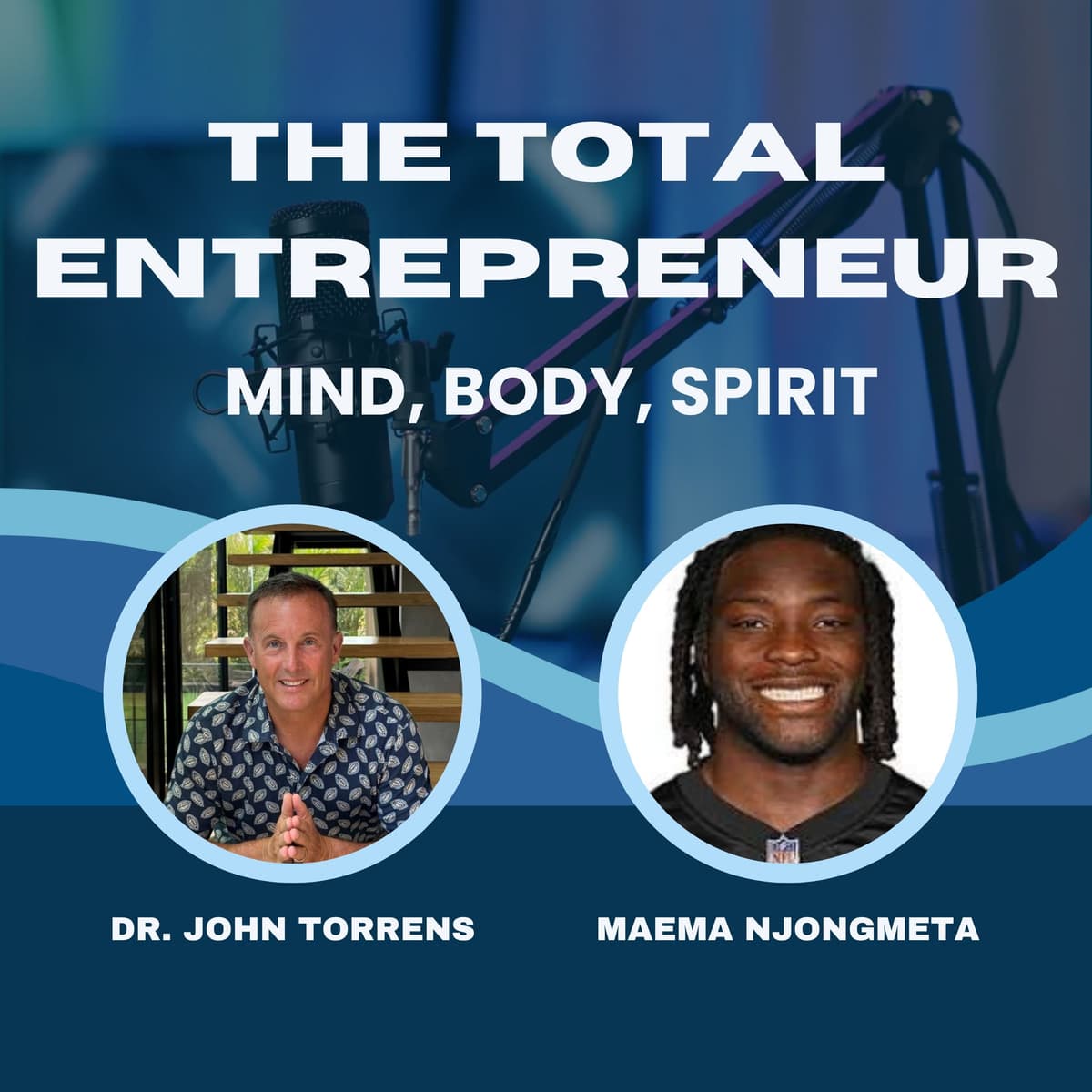
Athlete Mindset for Entrepreneurs - NFL Linebacker Maema Njongmeta
Aug 28, 2026 · 00:49:29
Part of our conversations on
If I have this narrative that I am not athletic enough to play in the league, it will become a self-fulfilling prophecy.
Mmhmm.
Versus if I have this narrative that I am unblockable, I am comfortable in space, I am a seatbelt in coverage, I'm hard to deal with, I'm— I cause problems for the offense, I'm one step ahead of everyone. Like, you just tell these things to yourself. And it's not just like you just say it out loud. It's like you take time every day to visualize. And you calm yourself. And you sit in a place where you see it in your mind. You see yourself being that. Like, those things really work.
Muma, how are you, man? Really good to have you.
Doc, good to be here, I should say. But thank you. Thank you for having me.
Yeah, I know it's been a few months since we caught up in New York at Biz Week. So it's really, really good to have you here. I appreciate you taking the time, man. I know you're busy.
Thank you. Yeah, just in the ramping up pre-process to going to training camp. And this is a critical time.
Yeah. So you've got a really interesting story, and I wanted to start maybe with your immigration. You were born in Cameroon and you came to the US at age 3, I think it was, right? Yes. So maybe talk to us a little bit about that and, you know, what it was like growing up with parents who immigrated from Cameroon. And I know they had a big impact on you. So I want to— I want to start with that. Yeah.
Now, so my immigration story is unique. I was born in Cameroon. My parents were upper middle class in Cameroon. My mom taught at the University of Gounderé. My dad did research at the university as well. He had just gotten his PhD at the University of Liverpool, and the reason we immigrated was for education. We had a pretty good life over there, but my mom wanted to get her PhD, and she was a Fulbright scholar. So we actually immigrated to Texas, College Station specifically, as she was doing her PhD there. So grew up in the Lone Star State for, man, I want to say 8 years, 7 years. We moved to Illinois when I was 10. But before really exploring that, yeah, immigrating was different. It was, it was, it's so funny to look back now all these years how it's impacted me, like just being in a new country, new customs. They speak English in Cameroon, and that was the language I spoke at home, but I grew up in the French-speaking part of Cameroon, so I actually grew up speaking French as well. And then I've soon forgotten it because my parents didn't speak it in the house, but I was speaking French as a kid, and it's just so funny just how different things are 22 years later. But my mom got her PhD at Texas A&M, and I always say my parents are the American dream. They came here with With a little, and now they have a lot, and mostly because of their hard work, dedication, and them taking advantage of the opportunities that their education provided for them. So.
That is cool. Is your mom an academic still?
No, both my parents have switched into the managerial side of things. So both started off as academic scientists. My dad's an epidemiologist, so he, he works for AbbVie. He's a global health officer. there. He's specialized in safety, so lab safety, and it helps because he's actually done the things he's kind of— here, you need to be safe about these things. And by the way, I've actually done the things I'm talking to the people he's talking to about. And my mom is head of innovation at Kraft, one of the heads of innovation at Kraft Heinz. So that's them. Yeah.
Now, growing up with parents who immigrated from a A foreign country, did you, did you feel different as a kid or not really? You know, I'm always curious because especially you came here pretty early, so maybe it—
Yeah.
Yeah.
So I always, I really did always feel different. I always felt, you know, I grew up around a lot of white kids and I always felt like too, you know, Black for the white kids, too white for the Black kids, too African or not African enough for the African kids, you know, just feeling kind of and I heard this term, it's called a third culture kid. And it's like when you're a child of parents who— and you grow up in a place that is different than your parents' passport country.
Mm-hmm.
So like you're growing up in a different country than where your parents are originally from. And it's— there's a unique term for it. And it described me perfectly because you like grow up between worlds. Like you— yeah, I grew up in America, but at home it was like Cameroonian culture. We ate Cameroonian food, listened to Cameroonian music, and then You know, feeling like, oh, I'm really from this place, but I'm growing up here. And then I go back to that place to visit, and I don't really feel like I'm from there either. It's like you grow between worlds. And it used to feel like a weakness for me, but it has— I've soon made it— I made it a strength. You know, I started to realize like this growing up between kind of worlds has definitely made me able to relate to people better in a lot of different ways, being able to not necessarily fit a box that people can just pin me in and instead be able to flow between categories of people, of backgrounds, ethnicities, beliefs. It's definitely turned into a strength, but it was hard, you know, as a kid.
Yeah, I could imagine that would be difficult. You know, it's just having, like you said, it was third culture.
That's what it is. A third culture kid. Yeah, I heard that term recently. It's really unique.
That makes a lot of sense. Yeah. So what's your go-to or what's your favorite Cameroonian food?
Yeah, so an easy one is beans and puff puff. So if you've ever had puff puff is like beignet. So if you've ever had beignet, but it's like smaller and it's not as powdery. Like beignet is like dessert. Puff puff you can just you just eat. So it's not as sugary, but it's that kind of texture, that kind of feel. That I mean my mom makes jollof rice, which is delicious. We have this very unique delicacy called atro soup. Achu and yellow soup. Achu is A-C-H-U. If, you know, we get off this call and you want to look it up, it's like pounded cocoyam and then this stew that you eat with your fingers. It's a delicacy. It's so good. Yeah, very, very good food. Cameroon has very good food.
What are your skills like in the kitchen?
Honestly, ever since making it to the league and realizing, like, if I want home-cooked food, my mom can ship it, yes, but I might have to start learning some things. So I've actually became a much better cook, like much, much better. I really enjoy it.
That's cool.
Yeah.
You know, I, I, uh, I've become a better cook as I've gotten older, right? Just because you can control the ingredients and it's, you know, you get a little more fussy and that sort of thing. Yeah. Well, no, thanks for sharing your immigration story. I think that's a cool part of, of who you are, you know?
Yeah.
Well, so, so you got a, you got an athletic scholarship to University of Wisconsin and played there. And then you actually, I think you went undrafted in 2024, even though you were a, you were a Big Ten standout, right? So then, then you kind of stayed with it and you got drafted by the Bengals. And so tell us about that arc, because to me, that's a really great story of, of resilience, overcoming adversity, and just kind of, you know, reaching for your goals despite an early setback. So talk to us about your early league arc there.
Man, I could even wind it back. So I started playing football in high school. I don't know if you knew that. So I was like late to the game in a lot of ways.
You're old compared to a lot of the kids you were competing with, probably, or at least late to the game, right?
Yeah. Yeah. So I was delayed, quote unquote, to the game in that sense. And that was hard because, you know, I was picking up a sport and I'm grateful I went out for football. The goal was actually never really to make it this thing. It was just, you know, hey, I want to play football. I thought it was an easy way to get girls. I thought it was like— it was like a scheme, you know? Like, it was very innocently a scheme. And, um, that was why I started. But I quickly fell in love with the camaraderie, the toughness, the mental discipline, um, it took to improve. And by the time it was my junior year, I was— I was getting looked at by a lot of schools, but no one really pulled the trigger, uh, until Army Army was my first offer. I remember I dipped out of AP biology, took the call in the bathroom, you know, told my teacher I was using the restroom. Should have told her I was taking a call, but just dipped out and got my first offer. Felt like I was walking on a cloud. Had a lot of Ivy League offers, a lot of mid-major schools. And then Wisconsin was like super late to the game. Like they, it's funny, they had offered 2 guys. And one like went to Oregon, and this other one, it was like they he was the final offer, and it was between Wisconsin and Notre Dame, and he chose Notre Dame. And all these years later, I met him at the combine, and I was like, "Hey bro, I don't know if you knew, but like when you declined your offer to Wisconsin, they ended up offering me next. I went there, boom, and now you know you went to Notre Dame, you did your thing, and now we're meeting here." It was like a crazy, crazy, crazy full circle moment. But yeah, so Wisconsin comes late, like so late, like the season's over and they hadn't offered me. So my season was over. I remember sitting at home. I had applied to zero schools at that point, like, 'cause I'm like, oh, I'm supposed to, you know, I'm thinking I'm gonna go D1. I feel like my life's over. I don't know what's going on. Wisconsin came into the picture, offered me, and going there was awesome because it was like a combination of athletics, academics, and, you know, big-time football experience. It was close to home but far enough. Like, it was just kind of the perfect— situation for me. I feel like God really had chosen Wisconsin for me. Like, it was just the perfect match. And while I was there, I was able to do my finance undergrad in finance. And then I was in a 4+1 program, which if you stayed an extra year, you could get your master's in applied securities analysis. So I got a master's in finance also from Wisconsin. I think it's the greatest school in the world.
Yeah.
And even my journey at Wisconsin was kind of tumultuous. I was— for 3 years, I didn't see the field. And all these years later, I can look back and say, like, I was behind guys who— like, the 2 dudes I was behind— I was behind 3 dudes. One of them has been to 3 Super Bowls in his first 3 years of being in the NFL. He's won 2 of them. He's played in all 3. The other one started for the Bears as an undrafted free agent. Like, just unheard of. Still in the league to this day. I think he's going on to his 5th year. The other one coaches in— for the Kansas City Chiefs now. He had his stint in the league. He kind of got shortchanged by the whole COVID rule changes during, you know, for— in the NFL, the league changes during the NFL during COVID But I mean, I was behind 3 guys who all went to the league. And so people— you don't know that in the moment, right? So people just think like, oh, this Muma character, he's unserious, you know, all this, all that.
Um, and—
So when I finally got my opportunity my 4th year, I really made the most of it. I'm thankful for the coaching I had around me at the point, the support I had, you know. And long story short, played really well my 4th year. My 5th year, combination of factors. I don't like blaming people. We got new coaches who me and them didn't see eye to eye on a lot of things. They asked me to gain a lot of weight. I broke my hand. There was just kind of a series of unfortunate events. But I was able to stay healthy and locked in mentally enough to— there were some guys, the guys they started in front of me, at one point one of them got injured, he got a concussion. So then I was able to have a stretch of 3 games where I played really well. Um, we played Ohio State, they were the number 1 team in the country. I had like 13 tackles, TFL, a fumble recovery, a sack. Like, I just had, like, I just had a little bit of everything. Um, played Illinois, had a double-digit tackle game, and then when We played in our bowl game, we played number 10 LSU, and I had a field day. And so those 3 games combined with what I did in my 4th year, plus, you know, the character that I had and just like kind of the intangibles that I had as far as like what I could bring to a locker room, I think were enough to push the needle for me to get in the NFL. Even that was— there was some adversity. I ran a really bad 40 time at the Combine on national television, like absolutely blew the waters in terms of what I needed to do. Was able to bounce back at Pro Day 2 weeks later. Like it was just a whole— it was like a year of just like— It's like a boxing match, you know, 17-round fight. And it's like, you think, boom, you get hit. You think it's a knockout punch. And just being able to get up off the mat, you know, when the count got to— before the count got to 10, sometimes it got to 9, and just feeling like, man, there's no way I can come back from this. And just being able to stay in it. Was able to go undrafted. Had a really good preseason and made the team. And that was such a magical year. It was just— 2024 was just such a magical year for me. In the sense of just the ups, the downs, and never feeling like I was quite in it, but never feeling like I was quite out of it, and just having to kind of march through the uncertainty. It was really hard. It was really hard, but it was worth it for sure.
Yeah. So it's not the type of thing where you were always at the top of your game, you were always the number one guy, and it was just a foregone conclusion that you were going to go to college and play D1, and then you were going to go to the league, right? I mean, you had to— there was quite a bit of mental toughness. in addition to everything you had to do with your, you know, with the game and your skills and just overall health, you had to stay in it mentally. And I like what you said too earlier about, you know, just the other things you bring to the table and what you can bring to the locker room. Because, you know, of all the guys that, you know, I met and worked with at Bizweek over the past few years, you know, we've just had this cool relationship and you are a very, you know, you're just very open and generous and easy to talk to. And just like a, yeah, like I would imagine if I were a head coach, I'd want a guy like you in the locker room. So I think that's really cool.
I appreciate that.
Yeah. All right. So, so not only were you playing professional football, but, but you went back and got an MBA at the same time, right? So, so you were doing 2 things that most people could handle, like one of them, right? Like, sure, maybe play in the NFL, then maybe people can get an MBA. But you just decided to do them both at the same time because, you know, why not?
Why not? Yeah, that one was, that was, that one was, it's crazy when you look back It's one of those things where, for lack of better words, sometimes impulse control is, is not my strong suit. You have a book on ADHD, don't you?
I do. Yeah.
Yeah. Yeah. Yeah. I need to read it.
It's not really my thing either. Yeah.
Yeah, I need to read it because it'll be like, just what I'm saying, like even the football thing, like the element of naivety, like not being naive almost can be a benefit because you don't know how hard it will actually be. And like going back to get my master's after take— I took a, I took a year off. to go to the league. And then in my offseason, I came back and did it. Like, I didn't know how hard that transition would be coming back. And just being naive helped me because by the time I was in it and I was realizing like, wow, this is actually really hard, it was like too late. I was already committed, already had the lease signed. I was already, you know what I'm saying? It was like the third week. I was like, all right, this is— I just— this is what we're gonna do.
So. Yeah. Oh, I mean, I guess that's a blessing, right? Because had you understood up front you know, how difficult that might be, you might not have done it, you know?
Yeah.
Yeah. But it sounds like your parents were a big influence in education. I mean, 'cause you didn't necessarily need your MBA at that point, but like you said, you had the deal with Wisconsin. They were like, hey, if you come back, you get the MBA. So you did it. So yeah, like talk a little bit about more the motivation to do that, especially when you're a, you know, relatively young player in the league.
Yeah, it's interesting. So I think in the moment it just felt like this is what I'm supposed to do. There was no pressure from my parents. I think it was just in my mind, like, hey, if I don't do it this first offseason, there will never be— like, I will never have a reason to go back. Like, I just won't have a reason to go back. And I'd already put in— so it's a plus-one program, but like, in your fourth year, you start taking classes for it. So it's like really like a— I put a year and a half in, and I had one— I'd put 3 semesters in, I had one more. And it was like— I have it like it's already in front of me. Why not go get it? And I mean, my parent, the pedigree of my parents makes it just almost like an unspoken expectation of just like, yeah, academic excellence is like just what we do in this house. Like I grew up going to graduations for doctorates and masters, and it was just like, this is just what we do. And so they never like said, hey, you're you're you know you're going right. It was just like, oh hey guys, I'm gonna go. They're like, okay cool. Let us know what you need from us. But I'm glad I went. I had a splendid time. And like, the other facet of it is I had a vet tell me like, hey, the second you enter the league, you're closer to retirement than you are to the beginning of your career. It's like— and so it's just the nature of like, one day— I feel like I have the greatest job in the world, and I want to keep it for as long as God will let me. And as long as they'll let me in a locker room on one of the 32 teams, you know?
Mm-hmm. And—
Yeah, I know one day they won't and the music will stop and the doors— the calls will stop being answered and the doors will close. And everyone— it comes for everyone. And so I want to be the one who says when. Like, I want to say when, you know? And like, maybe that's a little naive, maybe that's a little narcissistic or whatever, but I want to say when. And if someone else has to say when, I want it to be like, all right, cool. Well, good thing I have all this other stuff going on.
And I want to, I want to talk about all that other stuff because it's, it's, to me, it's really interesting. And, you know, we talked a little bit about it in New York at Bizweek. So, so before we get into like all your other interests and like the portfolio you've got, um, what was the, what was the main motivator for even going to Bizweek in the first place? I mean, you've got a, you've got a finance degree, you've got an MBA, you're probably, you know, you're probably more ready than most guys to tackle life in business after the league.
Yeah.
So what was the motivation to go?
Yeah, for me, Biz Week was just another opportunity to continue connecting and building a network both inside the league and outside of the league. I'm always looking for guys who are like-minded. And the thing about something like Business Week, that was the— I also did a music week in LA. The thing about trips like, you know, trips like that, the guys who go on, it's all optional, it's all paid for. The guys who go on that. So the only thing is like, are you willing to take a week out of your offseason and do something different? And so like, just that alone self-selects for guys who are like-minded. Like, I feel like who are passionate, who are ambitious, who are driven, all these things. And so like Business Week was awesome. I met all these guys whose numbers I have and like we'll text occasionally or keep in contact. And it's like, I know that if I'm ever in your city or if I'm ever like, if there's a project, like I just know that I have this network of guys who like Hey, this guy's like me. He has this drive. He has this ambition. He's pretty cool. It just kind of builds that network and brotherhood, which there's guys on my team who are really cool, but it's like there's so much that guys get caught up in during the season and in team dynamics. And it's nice to break outside of that and just meet guys across, across teams who are similar and like-minded. Then the cool experience of just being You know, Biz Week was awesome. Like, both meeting the people that we met, like the, the subject matter experts who were able to come in and just contribute their, their time, their knowledge, kind of guys like you, guys like people at Ramp who were able to help us with the competition, the entrepreneurship competition. Like, it was just, it was such a wonderful experience. Even Us going to Core Club, you know, I met the head of memberships there. And when I was in New York, she invited me over for the Knicks watch party game. Like, just being able to do stuff like that and build that, continue to build that network, it just was kind of a no-brainer for me. And you never know what you're going to get out of a trip like that. And but I've only gotten good things. It's only always been surprisingly good experiences. So that was another one of them.
So we talked a little bit about the connection between everything it takes to perform at an elite level, whether it's on the field or in a boardroom. So talk to me a little bit about the, I guess, the discipline or the routines and habits you have as a professional athlete and how you see that translating to your business endeavors.
The thing I think that— the things that separate the goods from the greats are super tangible, and they're very— I think they're very simple. I think for a long time I was a kid who was always looking for like the esoteric answer, the otherworldly, like mystical answer of like, oh, this guy's better than me because he's— I don't know, he was born under a lucky star. And I think there are some people like that. Like Ja'Marr Chase does all the right things and he was born under like the football gods looked down kindly on him when he was born. You know what I'm saying? Like he's just special. But like the ones who Are really, really, really, really good at what they do. Like the skills they have are the skills I've started to really tap into, especially as an undrafted guy. Like a guy who, like, I'm not going to blow your socks off, relatively speaking, because of my athleticism, you know. But I know if I'm super consistent, I don't know if I'm super prepared. I know if I am, man, if if I execute at a high level consistently. Like, that'll separate me from so many other people because it's really hard to do that. Mm-hmm. Like, learning that, oh, that's actually really hard to do. It sounds like really simple, like, oh, just execute consistently. Oh, but then it's like, okay, so I have to be emotionally consistent. I have to be like, my inputs have to be the same so my outputs are the same. Like, just finding out, like, there's so much that goes into that level of consistency. Like, that's a— it's a life skill. I'm just happening to apply to football right now, but once I have, I have, and I know I can apply anywhere else.
Mm-hmm.
And so then it's like the leadership aspect, learning to work together, being able to bring teams together, being able to be a glue guy. Like, how do you talk to people who are different from you in terms of motivations, in terms of upbringing? But we all have the same goal. So now we're trying to work together and find a way to make you know, our connectedness be the edge that takes us to the top versus other teams' connectedness, for example. And kind of just learning what works on a team level. Like, it's funny, I'll talk to my brother who— me and him were raised so similarly, right? But he sees the world so differently. And then when it starts coming to things like work and like, he was telling me how like, oh, like you just have to win, want to win more than the next person. And it's like people, I think people really think that. I don't believe that. I think everyone wants to win, especially when you're in the league.
Everyone wants to win.
Everyone wants to—
Right.
You know, but it's like, now, like, wanting it more doesn't actually make you better. It's all the other stuff. Like, are you staying consistently focused on the right goals? Are you working on the right goals? Are you efficiently using your time and your energy? Like, all these things that, like, you take for granted, I think, being in the league and just, like, having it modeled both poorly and well, you know, based on the teams you're with year to year or team to team. And, like, you kind of just build this mental model of, like, oh, this is what it— is supposed to look like. And I've been really privileged to be on some really good teams and have that modeled first and foremostly. But then I've also been privileged to be on some really bad teams and have really bad leadership and see what that does to the morale, to the output, to the execution, and be like, okay, this is what I like, this is what I don't like. And like, that is such an invaluable skill, I think, that I'm learning. So both personally for myself, what I bring to the table, and then like at a team-wide view like that. I hope this is answering the question, but like just seeing high performers perform at a really high level and then see high performers who have the potential to perform and then not, and understanding like, oh, okay, this is why. Being a high performer and like consistently executing some weeks and then some weeks being like, okay, I didn't reach what I could know I could have done. Why? Like being able to just like stay and just tweak this process. Like, I, I know it'll be something that I'll have with me for the rest of my life. I think that's the biggest— those kind of skills I've talked about are the biggest things, and they're very transferable.
Yeah. So what is the— what's the offseason life like for you? So like, you, you're still, you know, focusing, you're still hitting the gym, you're still focusing on nutrition, you're probably prioritizing good sleep. Um, but what does that generally look like, and how does that feed into you being able to just mentally stay with the, with the program that you have to have?
Yeah. So I read this— I was reading this little like blog or article. It was like how to do great work. And I forgot who wrote it, but it was really, really, really good. It was like really insightful. One of the things the person talked about was like the ones who are really good, like the advantage of experience is you understand what you actually don't need to pay attention to. Yeah.
Mm.
You know, when you're— and I had a— I had one of my teammates, I played with him in college, running back. He plays for the Colts now. He was like, see a little, see a lot. See a lot, see a little. And so, like, this whole idea of, like, the offseason doesn't need to be this whole thing where you're like, all right, I need to uncover and rip apart football and understand it from the ground up. Like, it doesn't have to be that. But Being, being able to have an intentional focus, like seeing a little so that you can see a lot, being able to like hone in on like, okay, very specifically last year I struggled with this, or this part of my game still hasn't gotten better yet. I need to do these 2, 3 things to improve. So like every offseason except my first one, granted I was getting my master's, has all been directed into like, what will— how will I play better this year? How will I play better this year than I did last year? And what I've started to realize is, like, the physical everyone kind of addresses. There's a couple types of guys in the league. There's the type who doesn't work out in the offseason. That's their problem. They're not trying to be in the league for long. Most guys work out, though. Most guys are, like, trying to physically get themselves ready. And so, like— but a lot of guys just stay there. And what I've found to be my edge, or what I've tried to find— have my edge be, is, like, to make sure I'm getting mentally ready. And so that's a combination of, like, My last 2 offseasons, I've gone on retreats. So, like, I went on a 10-day silent retreat my first offseason. This offseason, I was in Arizona for a week doing an intensive retreat, right? Getting my mind right, working through things so that, you know, the season is a pressure pot.
Mmhmm.
It's like, and if you can't take the pressure and you crack, and it's like week 12 and you have 5 more games that could either take your team to the playoffs or Take your butts to Cabo early. Like, what are you— what are you gonna do? You know? So for me, that has been getting my mind right. You know, journaling, going to therapy, just getting my mind right. Um, and taking some trips, taking time to relax. Um, all while having a regular cadence of training.
Mmhmm.
Because at the end of the day, it's the offseason, but you're not really off. Like, offseason does not mean off. You know, it's, it's just a different type. And sometimes that also means growing myself career-wise as far as like networking, right? You know, in my mind, the healthy human is physically strong, mentally strong, spiritually strong, emotionally strong. So like, you got to work on all 4.
Mm-hmm.
Like, you know, like my offseasons with the retreats, whether it's spiritually or mentally getting right, emotionally getting right, like making sure I'm reconnecting with my people. My parents, my friends, like, just all those things go into being mentally sound and physically sound to have. I mean, you're going to battle for 20-plus weeks, you know? Like, it's not just this thing. It's real. It's serious. So being able to address and have an offseason like that that addresses all those things is really important.
Yeah. And do you find that being mentally right or just having that mental discipline or toughness translates to physical, makes it easier, in other words?
Yeah, I had a coach say that where the mind goes, the body follows. And it's so true. Like, yeah, it's so true. It's like if you— the mind is so powerful and I'm a big, I'm a big mind freak. Like, I don't know how else to say it. I'm a big, like, visualization. Like, I read this book, Psycho-Cybernetics. That was the book I read before my, um, my fourth year. I just had this like kind of— I revived my career. It was because of that book. And the whole essence of the book was like talking about reworking the self-image you have for yourself and how like you can only do as much as your self-image allows you to do. And it talked about hypnosis and how like, I mean, if you watch someone get hypnotized and like you just put them in a state where they're susceptible to autosuggestions and you tell them, you know, it's really cold on this one spot of your body, they'll start shivering.
Mm-hmm.
Or you tell them like you're like, you put a pen on the table and you're like, hey, you know, this pen weighs 1,000 pounds, you can't lift it. And they'll struggle. And it's real. It's like you can see it. It's like that is just what the mind is on it. That's a microcosm for where the mind's at. And it's like understanding that, like, if I have this narrative that I am not athletic enough to play in the league, like, I will— it will become a self-fulfilling prophecy.
Mmhmm.
Versus if I have this narrative that I am unblockable, I am, I am comfortable in space, I am a seatbelt in coverage, I'm, I, uh, I'm hard to deal with, I'm— I cause problems for the offense, I'm, uh, one step ahead of everyone. Like, you just tell these things to yourself, and it's not just like you just say it out loud. It's like you, you take time every day to visualize and you calm yourself and you sit in a place where you see it in your mind, you see yourself being that, like, those things really work and some people don't believe in it. And I've seen it absolutely change the trajectory of my career, you know, and I believe in lifting the weights like that's really important. But it's like, again, your mind will take you much further than your body will.
I've heard you talk about staying calm as a cucumber. in a high-pressure, high-stakes game with millions of people watching, right? So how do you, how do you actually do that? I mean, I think most people would just freak out, um, you know, even, even, you know, professional athletes, you know, with millions of people watching in a high-stakes scenario, that, that could be a lot. So how do you maintain that composure?
I think there's, um, man, I'm not, I am not the always best, most calm person. I've gotten so much better. A lot of it is detachment, just like, all right, it is what it is. It's so funny, like, I think through this past season and the one time where I really actually got super hyped about something, we ended up losing. It was so soul-crushing. It was the playoffs. We blocked a punt. If you do the math, right, if you block a punt, your chances of winning a game go up by like 80%. Like, it's actually insane. Like, it's insane. So we blocked a punt. with 3 minutes left. We were down by 4. We blocked a punt with 3 minutes left and set our offense up for the go-ahead score. Like, so I'm on the sideline losing my mind, like, oh my God. Like, we block it, obviously run to the side. I'm like, oh my God, this is insane. Like, this— like, we really might win this game. And we lost. So I— like, that's so tough because normally I don't let myself even celebrate that. I'm like, all right, cool, we blocked the punt. Okay. Oh, cool, they blocked the punt. All right. Because it's just— It's just so like, one, they're so good too. They get paid. They're professionals. They have their own process. They're doing their own thing. They have their families to feed. But two, it's like, it's kind of like that whole 17-round fight mentality I was telling you before. It's like, as long as it's not the knockout punch and there's still time on the clock and there's still breath in my lungs and there's still this and there's— it's like, it's truly like— It's never too late. Like, it's really just never too late. So like, the whole staying calm thing is a lot of it is detachment. A lot of it's like, it's tough because it's not as fun to play. Like, it's not like— I don't know if I can say this publicly, but it's not as fun that way. Watching the game as a spectator is so fun, but watching it as like someone who's playing, because it's your job, like you say, all right, well, this happened. Okay, what does that mean? And you're just thinking, you're just so analytical about it.
Hmm.
Like my rookie year, I was still learning this. Like, how am I approached now? And like, I remember, I remember something crazy happened and, um, their offense scored. We were playing the Commanders, their offense scores, and I'm like, oh my God, no, no. I'm like really thinking about it whole time. Field goal block's going out there, I'm on field goal block. We end up— they end up kicking it, they do a normal field goal, but we had 10 men on the field. It was like my coach cussed me out because he was like, bro, like Like, we like that's you, you know? And I just remember being like, okay, so like I need to change how I'm watching this game because when you react to it, it like you get caught up in the emotion emotionality of it. So like staying calm is a cucumber for me. A lot of it's detachment. A lot of it's breathwork. A lot of it's just staying present. I'm gonna say if you want to enjoy it, like feel it and then let it go. But it's like guys want to be like, oh my god, like we're up in this and this and this and it's. It's the NFL. People lose focus all the time. We were down 17 points to the Dolphins, I think going into the 3rd quarter, maybe the 2nd quarter. And it's like, that's really painful. That's really shitty. If you— if we really let ourselves get in that moment, like, it would've been like, wow, this is over. Like, this is done. We're done. It's like this narrative people tell themselves. So like being able to just capture and be like, ah, this is just a thought. Let's go back to what's actually happening.
Like, no, I like that because, you know, if you're, if you're so focused, whether it's high or low, right, if you're so focused on what's coming next or, oh, we're going to win this or, oh, we're going to lose, whatever, you're not really focusing on the moment, right? And I think that's kind of what you're saying is you have to be present, right?
Yeah.
Like you said, the Dolphins went up 13. That happened for them. There's no reason it couldn't happen for you guys afterwards, right? It's just you got to stay focused and stay in it. Yeah, yeah, I like that.
No, I—
so I listened to your graduation speech, uh, that you gave at Wisconsin, and you talked about the difference between your, your vocation and your, uh, what was it?
Occupation.
Yeah, yeah, I was gonna say, yeah, avocation. But yeah, your vocation and your occupation. I thought that was kind of cool. You mind sharing that with us?
Yeah, so I had, um, I made the speech. That was a fun speech to write because, uh, basically I had wanted to, uh, give this speech and I Basically hadn't registered my final class to graduate, so they didn't know I was graduating. So I wasn't getting the emails for like, like to apply to give the speech. The only reason I like— it was just this whole like back behind the background thing. But so finally I wrote this speech, like I had to write the draft the week before, like the, the, I guess there was auditions for graduation speakers. I had to write the draft a week before. So I wrote in a week and the court principle I really wanted to share was like both the time at Wisconsin, because I love the school and I felt like I went from being a boy to a man during my time in Wisconsin. But I also really wanted to communicate something. And I knew that the thing that's going to really attract people is like, oh, it's an NFL player giving the speech.
Right.
Like, and I wanted to like, sure, we could talk about that, but I wanted people to understand that it's not just What you do, but it's like how you do it and why you do it, you know, your purpose behind doing it. And backtracking even a couple months before that speech, we had a new coach, a new linebacker coach, and he had said one day, like, you know, he was talking about gaps and like, you know, he was like, your occupation might be the A-gap, you know, you're supposed to be in the A-gap, but the ball's in the B— is in the C-gap. You know, at the end of the day, your vocation is tackling the ball. And I was like, it was like this whole football thing. But I was like, damn, like, that's really deep. You know, you might have this occupation that tells you this is where I'm at, this is where I need to be. But don't let that ever, ever, ever get in the way of your vocation, of your purpose. And, and I felt like, you know, I started playing football. It was a scheme to make friends, win influence, get girls, all the things.
Mm-hmm.
And the reason I really, really stuck with it was because the person I had to become, the type of person, the type of man I had to become to excel at the sport. I had to become a more consistent person. I had to become more trustworthy. I had to lead myself better before I could ever lead others. Like, it was all these, all these things.
Mm-hmm.
And I realized over the time that, like, I developed into a man, and the type of man I wanted to continue developing into was someone who was a servant leader. I realized that was my vocation, that was my passion, that was my purpose. And so when I was giving the speech, I was like, man, I have to bring this up. This is so integral to who I am. Like, I want people to understand that, yes, I play in the NFL, but I could be out the league tomorrow and this part of me would never change. And so I hope I communicated that well during the speech. I really enjoyed writing it and I thought it was received well, but it was from a deep, deep place in me that I spoke. that speech.
Yeah, I, I mean, I wasn't there in person, obviously, but yeah, I checked it out online. I thought it was— yeah, I thought it was really good. Yeah, I mean, we talked about ADHD. Like, normally I'll, I'll watch the first couple minutes, skip ahead to the end of something, and say, all right, I got it, you know? But yeah, yeah, yeah, you held my attention the whole time, which is good. So—
Oh, that's, that's a big compliment. I'm not gonna lie.
Yeah, that was definitely no small thing. So I gotta ask you, was, was that more stressful Or I read somewhere that you were the valedictorian of your 8th grade class.
So you did all your research, by the way.
You sang at the ceremony. So which was more stressful, giving your MBA speech or singing for your 8th grade graduation?
Well, honestly, probably my 8th grade speech because I was— I wasn't as practiced. Like, I love speaking in public, but in 8th grade I had very little practice. And like now I Every time I go back home, there's always like two or three speaking opportunities. I always say yes, just to keep practicing that, building my portfolio and repertoire. So definitely my great speech. You did all your research, by the way. That was pretty good.
What was the song you sang? I couldn't find that.
Oh man, this is. I'm gonna get flagged for this. I sang "I Believe I Can Fly" by a certain artist. If you know, actually, I have.
I have a note here that says you you volunteered to sing that for us today. Is that true?
Oh no, I don't know who wrote that note. I don't know who wrote that note.
No, I'm just teasing. So, so let's fast forward a little bit, right? You talked about, you know, the fact that, yeah, nobody plays in the league forever. You're kind of preparing yourself for the next stage. You've got some business interests now. And so talk to us about what you're up to now, what you're looking to do, and kind of, you know, what you see your life like after the game.
Yeah, I think it changes every day. It's so funny. Like, I'm still trying to figure out what I want to be when I grow up. And The thing, the latest thing on my mind actually is construction. Funny enough, I've just, I guess, started to meet a lot of people who do it, a decent amount of people who do it. And like, I know nothing's easy. Anyone who's ever said like, oh, it's easy to make money in this business, I know they're lying to me. But—
Right.
Something about the construction, it, it just speaks to me. Like right now my goal is I want, when I'm done playing, I want to, one, I don't want to take a pay cut, which like that's a very high bar. And then 2, like, I, um, I want to be passionate about what I do, um, but I want to— I want to also make mailbox money. Like, that's kind of the phrase that's just so catchy.
Mm-hmm.
I don't want to take a pay cut, and I want to make mailbox money, um, and I just want to have autonomy over my life and like where I'm at, when I'm at, why I'm at. At those places, I want to be able to have more control over that. And so, for me, that means building a portfolio of passive income right now and through a series of investments. I also went undrafted, so my pool of resources is not necessarily as big yet. So, like balancing between like all right, I want to make bets that like the reward is commensurate with the risk I'm taking. Right? But I don't want to take any ruinous risk, like risks that'll set me back in a way that I can never recover from. And so I'm look— I'm just learning right now. A lot of it's learning. The actual investing I'm doing is very much like conservatively investing the money I'm saving with my financial advisor. I want to start looking into being able to value deals, right? Like we had talked about this venture capital deal. This company that does autonomous vehicles, but just being able to develop a framework to understand deals because I one is my background. You know, securities analysis is my background, but I want to be able to take that on a larger scale, and then I want to be able to recruit my teammates. Like I'm building this huge network of players who like not everyone is Patrick Mahomes or Tom Brady where. They don't really need to make money outside of football. Like, they've they could, but they don't. Like, they've already made their generational money in football. I know a lot of mid-tier to low-level guys who maybe they're P squad players, but they have a good steady income. They've saved it, and now they want to take it and leverage it and turn into something bigger. Like, those are the types of dudes I would want to work with, pull our money together, and be able to invest in like real, you know, alternative assets. Like. why not invest in, in a music catalog and get— be able to get a cash flow from that? Or why not be able to invest in, you know, a venture capital deal or, you know, syndicate loans and invest in a REIT or invest in some construction projects? So I just want to be able to, like, learn. I'm just trying to follow my curiosities right now while also staying grounded in, like, practical things. Like, I'm investing in a historical landmark in Madison. I can't really say too much, but it's the deal's closing here probably by the end of this month, and I'll be investing in. I got approached for that, and like deals like that where it's like okay, this speaks to me as my connection to Madison, but it also is like it makes money sense. Like this is something I want to be a part of. Okay, and I get to it gets my foot in the door to do more deals with these people further on in the future. Like that's that's kind of my approach right now, and I'm always just trying to learn and connect with people because. I know there's so much more that other people know than what I know.
So do you get pitched ideas all the time? And do you have a— do you have a mental process or even a real process for how you sort of vet them? Or— so I imagine people come up and say, hey, Muma, you've got this great thing, we'd love to have you involved. And how do you— how do you say no? How do you let them down?
Yeah, I actually don't get pitched that much. I, I don't get pitched too, too much, but I, I find myself scavenging more than anything. Um, but the nos are— the nos are pretty easy right now.
Mmhmm.
I think mostly because it's like, I, I know I'm still early in my career. You know, it's not like I have $10 million in my bank account where it's like I feel like I have a little more range, a little more ammo. Like, I know I have to be super selective. So it's like, I, I want— there's some things I want to say yes. Like, even the one we looked at, I feel like that was a yes, and I still said no because it was like, ah, this just doesn't feel like— this does not feel like a good first. It was a big real—
Yeah.
You know, non-tangible as like, it's, it's not a stock, which I'm good with. It's not a bond. It's like a— this is a real company. And I wanted to say yes, and I still said no because it felt like this just isn't Right yet, you know. So yeah, um, it's hard. I might kick myself in 10 years and be like, oh, but that's just the nature of things. So yeah, I'm okay with it, right?
But you know, there's also a chance you might be thanking your stars, right, that you didn't do it, right? But I think no matter what, like, it's, you know, maybe it was the right deal at the wrong time, but you know, you never technically lose anything by not investing in a deal, Right? Yeah, maybe you missed the opportunity, but, you know, now you've got— now you've got resources and dry powder for the next thing that comes along, you know? Yeah, yeah, yeah. Cool. So what are you looking forward to this upcoming— I mean, you only got a few weeks of summer left before you—
I have, man, what is today, Monday? I have like maybe 13 days.
Oh wow.
Yeah, yeah, maybe 13 days, maybe 12. Yeah, so What am I looking forward to? Um, man, this season or this offseason? This season I'm looking forward to a lot.
Yeah.
It's my contract year. Yeah, it's my contract year. I'm going in my 3rd year, last year of my deal. Um, I started playing football late, right? So high school. But I feel like I'm finally getting towards that place where I'm— my understanding of the game. Yeah, my understanding of the game, my technique, is really kind of becoming super uniform. And so I'm able to be way more consistent than I've ever been in all these different ways. And it's really cool to, like, cut the tape on and be like, wow, like, I feel like I finally am starting to look the part, you know?
Yeah.
And, like, that was the plan. That was the plan all along. Like, buy time with special teams so that I can start to look the part on defense. And I love special teams. And so, like, I'm in this place where I feel like I'm ready to embrace any role they give me. And if it's Purely special teams, I feel so confident I'm going to play premier-level special teams. And when the opportunity for defense appears, I'm so confident that I will show up and execute at such a high level that I'll be able to extend my time in the career, in the league, and I'll be able to really make the type of career I envision. You know, every time I close my eyes and visualize that, I see for myself. So I think this year has a lot. I think it's gonna be the best year of my life as far as football. And I mean, everything else, I'm just— I feel like I'm in a really good place mentally, spiritually, emotionally. And yeah, it's not just talk. Like, I did so much work for it. Like, I went on this retreat and I, you know, I like— I actually yesterday was a year of no alcohol, you know, so I put the liquor away, stopped doing all that nonsense. And like, I just feel so healthy, so in tune with who I am and where I'm at. So— I'm very excited and I'm excited to like Just go back to Carolina and continue bonding with the team. To me, it's important to play with guys like who I care about them, they care about me, and I feel like we're connected. Like that's super important. And so I'm just excited. I got we got a I got a new spot for this season. I was staying in Airbnb last year. This year I got like a nice little lofted condo. Like it's gonna be electric. Like there's so many things I'm looking forward to. The Panthers are gonna be electric this year. Like It's gonna be awesome. I play my old team from last year. I'm gonna knock some heads loose, show them why they should have never let me go. Like, it's gonna be— there's so many things I have to be thankful for. Um, you're gonna come to the game in Philly, you know, front row. I'm gonna see Professor John there. Like, it's gonna be awesome. No, I'm really excited. There's a lot going on. So just a, just a high-level overview of what, what's in store these next couple of months.
That's awesome, man. Well, well, Muma, I really appreciate you spending some time. I mean, like I said, you're just such a positive, uplifting presence. You know, just spending time with you always feels good. So I really appreciate you doing this. And I mean, based on everything you're doing and talking about, I have no doubt that, yeah, all that stuff is going to happen for you. So thank you so much.
I appreciate that, Professor. You're the man.
About This Episode
If you want to understand the athlete mindset for entrepreneurs, there's no better teacher than someone who went undrafted, made an NFL roster anyway, and is now building an investment portfolio in his spare time.
Maema Njongmeta is a linebacker for the Carolina Panthers heading into his contract year. Born in Cameroon and raised in Texas and Illinois by immigrant parents (his mother a Fulbright scholar, his father an epidemiologist), Maema went undrafted out of Wisconsin in 2024 despite a standout senior season, and made an NFL roster anyway. He also holds both a finance undergrad and an MBA from Wisconsin, earned while training as a professional athlete.
In this episode, he sits down with John to unpack the athlete mindset for entrepreneurs: the mental skills that separate good performers from great ones, and how he's applying the same discipline to building a life after football.
In this episode, you'll learn:
What it means to be a "third culture kid," and how Maema turned feeling caught between two worlds into a professional strength.
Why the athlete mindset for entrepreneurs comes down to consistency, not raw talent, and why consistent execution is harder than it sounds.
The book that revived his football career, and the self-image framework behind it (Psycho-Cybernetics).
How visualization actually works, and why the stories you tell yourself become self-fulfilling.
His approach to staying "calm as a cucumber" in high-pressure, nationally televised moments, and the role detachment plays in it.
Why he treats his offseason as training for his mind, not just his body, including silent retreats and therapy.
The difference between an occupation and a vocation, and why the distinction changed how he plays the game.
How he's building a post-NFL investment portfolio, from historical real estate to alternative assets, while staying disciplined about risk.
Why going undrafted may have made him a better long-term player than being a highly-touted pick.
Keep listening
More on Mind




About the Host
Dr. John M. Torrens
5× Inc. 5000 entrepreneur, Professor at Syracuse University's Whitman School of Management, author of Lightning in a Bottle, and TEDx speaker on ADHD as an entrepreneur's superpower.
Browse all podcast guests →Book a Discovery Call →